
Built-In Email Marketing with AI Assistance: Why Field Service Contractors Are Ditching Third-Party Tools
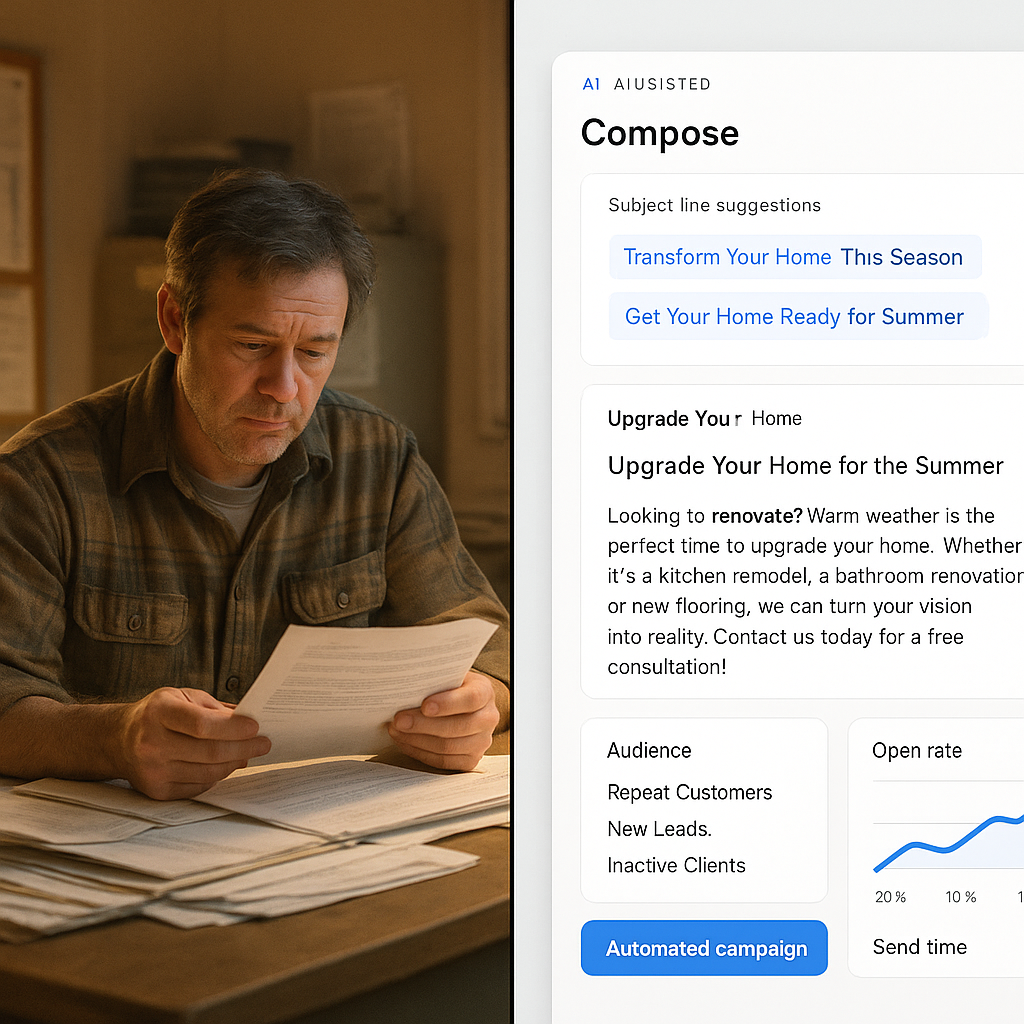
Built-in email marketing with AI assistance means your field service platform automatically sends relevant, personalized emails to customers using the job data already in your system — no separate email tool, no manual exports, no Zapier glue holding it together. For trade contractors running HVAC, plumbing, electrical, or similar businesses, this approach is fundamentally different from bolting a standalone email platform onto your existing software stack. Instead of logging into Mailchimp after a job closes, the platform detects the trigger — a completed invoice, a seasonal service interval, an open estimate — and generates the email for you. AI assistance means the content is written around the actual job performed, the customer's service history, and your company's voice. The result is timely, accurate follow-up that runs without anyone on your team lifting a finger — and that consistency is what converts one-time service calls into long-term customers.
Why Do Most Field Service Businesses Struggle with Email Marketing?
Most field service businesses struggle with email marketing because the people who know the customer — the dispatcher, the tech, the owner — are not the same people sitting at a desk writing campaign copy. The gap between finishing a job and sending a follow-up email is where most repeat revenue quietly disappears.
A five-truck plumbing company might have two hundred completed jobs in a given quarter. Someone would need to export that job data, match it to a customer list, write something relevant, and schedule the send — all in a separate tool that has no idea what work was actually done. That is not a marketing problem. That is a workflow problem.
The result is predictable: email marketing either never gets started or gets abandoned after a few months because it takes too much effort relative to the visible return. Owners know they should be following up with past customers. They just cannot find the time or the system to do it consistently. Consistency is the entire game with email — one well-timed message after a job closes is worth more than a monthly newsletter nobody asked for.
What Does 'Built-In Email Marketing with AI Assistance' Actually Mean?
Built-in email marketing means the email system lives inside your field service platform and pulls from the same job records, customer history, and scheduling data your office already uses. AI assistance means the platform does not just send a templated message — it generates contextually relevant content based on the specific job, the customer's history, and your company's tone.
This is not a chatbot writing generic copy. When a boiler maintenance job closes in your system, a built-in AI email tool knows what was serviced, when it was last serviced, and what the customer's follow-up interval should be. It writes the email around that context automatically — and queues it for delivery without anyone on your team touching a keyboard.
The distinction matters because most field service platforms that claim email marketing are really just sending automated PDF invoices with a reply-to address. True built-in AI email marketing generates campaign-quality content at the individual job level, triggered by real workflow events rather than a manual send button.
What Is the Difference Between a Standalone AI Email Tool and a Native One?
A standalone AI email tool — something like an AI writing assistant inside Mailchimp or a third-party campaign platform — knows only what you tell it. You still have to import the job data, define the audience, and prompt the AI with context about the work performed. That is two systems, two logins, and a human in the middle every single time.
A native AI email tool inside your field service platform already has the context. It knows the job type, the technician assigned, the materials used, the invoice amount, and the customer's service history. The AI is not guessing at relevance — it is reading your actual records. That difference in data access is what makes native AI email marketing produce better results with less effort, not just marginally better, but categorically better for a trades business where every email should be specific to what that customer actually needed.
How Does Built-In AI Email Marketing Use Your Job Data to Drive Repeat Business?
Built-in AI email marketing drives repeat business by converting completed jobs into automatic outreach sequences — without requiring any manual setup after the initial configuration. The platform watches for trigger events in your job workflow and uses the associated data to generate and send relevant follow-ups at the right moment in the customer's service cycle.
Consider a residential HVAC contractor. A summer AC tune-up closes in the system. The platform knows the service type, the completion date, and the recommended follow-up interval for that trade. It automatically queues a fall furnace check-up reminder for five months out, written around the specific equipment serviced — not a generic seasonal blast. That single automation, running quietly in the background, is responsible for a meaningful share of a contractor's rebooking rate across dozens of customers simultaneously.
The same logic applies to open estimates. If a customer received an estimate three weeks ago and has not responded, the platform can generate a personalized follow-up referencing the specific scope and price — not a cold reminder, but a warm nudge that acknowledges the original conversation. These are the moments where contractors lose revenue to silence, and built-in automation closes those gaps without adding to anyone's daily task list.
Can AI-Written Emails Actually Sound Like Your Business — Not a Robot?
Yes — but only when the AI has been trained or configured around your company's actual voice and standards. Generic AI email tools produce generic output because they have no reference point for how your business communicates. A built-in platform that includes AI training and customization features allows you to define your tone, your terminology, and your service standards, so the output reflects how your team actually talks to customers.
ServiceMerge's AI Marketing Email Generator works exactly this way — it generates campaign copy in your brand voice, not a templated corporate tone. Pair that with AI Training and Customization that lets you tune the AI to your company's style, and the emails your customers receive read like something a real person on your team wrote. That credibility is what drives opens, responses, and rebookings — not volume.
What Is the Real Cost of Stitching Together Separate Email and Field Service Tools?
The real cost of running separate email and field service tools is not just the subscription fees — it is the labor required to keep two systems synchronized, the errors that occur when they fall out of sync, and the revenue lost every time a follow-up does not go out because the process broke down. For a contractor running eight to twelve technicians, that invisible cost adds up faster than the line items on a software invoice.
Take a concrete example. A drain cleaning company uses a field service tool for dispatch and invoicing, and a separate email platform for customer outreach. Someone on the team needs to export completed jobs weekly, clean up the data, import it into the email tool, and manually segment the audience before any campaign can go out. If that person is out sick, traveling, or simply buried in dispatch changes on a Friday afternoon — the campaign does not go out. That missed send is a missed rebooking opportunity for every customer on that list.
Beyond the labor cost, there is the subscription overhead. Standalone email platforms with the features contractors need — segmentation, automation, analytics — typically run anywhere from $50 to $300 per month depending on list size and feature tier. When that cost is added to a field service management platform, the combined spend often exceeds what a fully integrated platform would cost at a higher tier with email included.
What Happens When Email and Scheduling Live in the Same Platform?
When email and scheduling live in the same platform, follow-ups become a natural output of your existing workflow rather than a separate project. A job closes, an invoice is marked paid, and the platform automatically queues the post-job email without any additional steps from your office team. Recurring job triggers, estimate follow-ups, and maintenance reminders all fire from the same event data your dispatchers and technicians are already creating in the normal course of business.
This integration also eliminates a category of errors that contractors with split systems deal with constantly — sending a follow-up to a customer whose job was cancelled, or missing a rebooking reminder because the export only captured paid invoices. When the data source is singular, the outreach is accurate by default.
Which Types of Contractors Benefit Most from AI-Assisted Email Marketing?
Contractors with recurring service needs benefit most from AI-assisted email marketing because the economic model depends on rebooking — not just first-time acquisition. HVAC, plumbing, irrigation, drain cleaning, and aquatics businesses all operate on service cycles where the customer who came back for a second or third visit is worth dramatically more lifetime revenue than a one-time call.
HVAC contractors benefit from seasonal maintenance reminders tied to system type and last service date. Irrigation companies need spring startup and fall winterization reminders that fire on schedule without manual intervention. Drain cleaning companies can automate annual maintenance reminders for residential customers who had a blockage cleared. Roofing and electrical contractors benefit from post-job review requests that increase referral volume over time.
In each of these cases, the value of the automation is proportional to how consistently it runs. A contractor who sends a maintenance reminder to every eligible customer, every season, without fail, will outperform a competitor who sends reminders when someone remembers to do it — regardless of who has better technicians or lower prices.
How Can You Tell Whether Your FSM Platform's Email Marketing Is Truly Built In?
A field service platform's email marketing is truly built in when it triggers from job workflow events — not from a separate campaign dashboard you have to log into and manage independently. If you have to export a list, import contacts, or manually define an audience before sending, the email tool is bolted on, not native, regardless of what the marketing page claims.
Ask three direct questions when evaluating any platform's email marketing capabilities:
- Does the email content automatically reference the specific job, trade, or service performed — or is it a generic template you fill in manually?
- Are email triggers connected to real job status changes in the dispatch board, or do you have to set them up in a separate automation builder?
- Does the platform use customer service history and job data to personalize content, or does it require manual merge field configuration every time?
If the answer to any of these is that a human needs to intervene before each send, the system is not truly built in. It is a convenience wrapper over a separate tool, and it will eventually break down under the operational pressure of a real service business.
What Should You Look for in a Field Service Platform with Built-In AI Email Marketing?
Look for a platform where AI email marketing is a native feature connected to live job data — not an add-on integration or a third-party plugin. The five capabilities that separate genuine built-in AI email marketing from marketing copy are automation triggers, data-aware content generation, brand voice customization, campaign analytics tied to job outcomes, and pricing that does not charge extra for each feature individually.
- Automation triggers connected to job status, estimate age, invoice payment, and service intervals — not manual campaign sends
- Data-aware content generation that pulls from the actual job record, customer history, and trade type — not a blank template
- Brand voice customization so the AI writes in your company's tone, not generic corporate language
- Actionable analytics that connect email performance back to rebooking rates and revenue — not just open rates in isolation
- Flat, predictable pricing that includes email marketing without per-feature or per-send charges that inflate the real cost
ServiceMerge includes all of these capabilities natively. The AI Marketing Email Generator writes campaign copy in your brand voice, and AI Training and Customization lets you tune how the platform communicates on your behalf. Combined with job-triggered automation, customer history, and flat-rate plans built for small and growing trade contractors, it is the kind of email marketing system that actually gets used — because it runs on its own. Explore the full feature set at servicemerge.com/features.html to see how built-in AI email marketing fits into a complete field service workflow.
If your current setup requires manual effort every time you want to follow up with a past customer, that effort is costing you repeat business every week it does not happen. Start a 14-day free trial at servicemerge.com and see what consistent, automated follow-up does for your rebooking rate.
Ready to run a smarter field service business?
Dispatch jobs, send invoices, collect payments, and track your techs in the field — with AI-powered scheduling, route optimization, and tools that cut admin work so your team stays on jobs, not paperwork. Built for many trades like plumbing, HVAC, roofing, and electrical — view the full list of trades.
Frequently Asked Questions
Can field service software really replace a dedicated email marketing tool?
For most trade contractors, yes — particularly for the highest-value email types: post-job follow-ups, maintenance reminders, and re-engagement sequences. A platform with built-in AI-assisted email marketing handles these automatically using live job and customer data, eliminating the need to maintain a separate email tool for day-to-day customer communication. Contractors who need advanced broadcast campaigns or complex drip sequences may still want a dedicated tool, but that is rarely the bottleneck for a business running five to fifteen technicians.
Is AI-generated email content effective for trade service businesses?
AI-assisted email content is most effective when it draws on real job and customer data rather than producing generic copy. For contractors, an email that references the specific service performed, the technician who did the work, or the customer's service history consistently outperforms a generic monthly newsletter. A built-in platform makes that level of personalization automatic — no manual merge fields, no data imports, no guesswork about what to write.
How does automated email follow-up reduce customer churn for contractors?
Most contractor customer churn is passive — customers do not leave angry, they simply forget to rebook or respond to a competitor's promotion before yours arrives. Automated follow-up emails triggered by job completion dates or service intervals keep your business visible at exactly the moment a customer is most likely to need you again. Consistent, timely outreach prevents the quiet drift that causes repeat customers to become one-time service calls.
What kinds of emails should a contractor automate first?
Start with three sequences that cover the majority of repeat revenue opportunities: a post-job thank-you and review request sent after a job closes, seasonal maintenance reminders triggered by job type and the date of last service, and follow-ups on open estimates that have not yet been accepted. These three automations require no ongoing manual effort once configured in a platform with built-in triggers, and they address the customer lifecycle stages where contractors lose the most revenue to inaction.
Do I need a large customer list for AI email marketing to be worth it?
No — a list of two hundred to five hundred past customers is more than enough to generate meaningful repeat business through targeted, automated follow-ups. Contractors with smaller lists often see stronger results than larger companies sending generic blasts to tens of thousands of contacts, because the emails are highly relevant to each recipient's actual service history. Relevance and timing matter far more than list size when the goal is rebooking, not brand awareness.