How Route Optimization Makes Life Easier for Field Service Teams: Real Time and Cost Savings
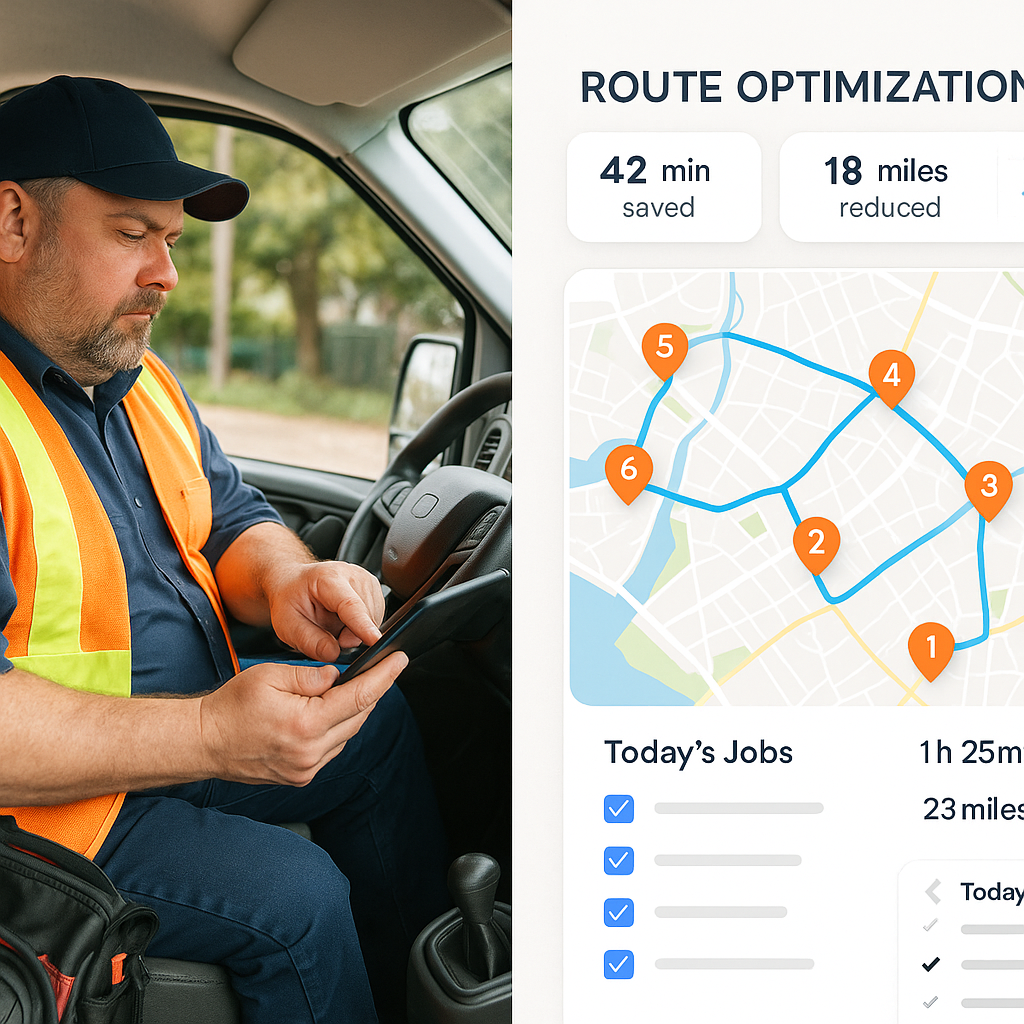
Route optimization for field service teams means more than finding the shortest path between jobs — it means fitting more billable work into every day, cutting fuel spend, and ending the overtime spiral that quietly erodes margins. For trade contractors running HVAC, plumbing, electrical, or any field crew, unoptimized routes are one of the largest and least visible drains on profit. A technician sitting in traffic between jobs that could have been sequenced smarter is not just burning fuel — they are burning labor hours you are already paying for. When routes are planned intelligently, dispatchers spend less time firefighting, technicians arrive on time more often, and customers stop calling to ask where their tech is. Modern route optimization software — especially tools built with AI dispatching — goes further by adapting in real time when jobs run long, emergencies come in, or cancellations ripple through the schedule. The result is a leaner, more predictable operation that earns more revenue without adding headcount.
Why Is Route Optimization Such a Big Deal for Field Service Teams?
Route optimization matters for field service because time on the road is time not being billed. Unlike a delivery driver whose entire job is transportation, a field technician's productive time only starts when they arrive at the job. Every extra mile driven between calls is overhead — and unmanaged, it compounds across every tech, every day, every month.
Think about a five-truck plumbing company running eight jobs per truck per day. If each technician averages 40 minutes of drive time per job instead of 25, that is nearly two hours of dead time per tech per day. Across five trucks, that is ten hours of paid labor producing zero billable output — every single day.
This is not a hypothetical edge case. It is the default outcome when scheduling is done manually by someone looking at a calendar rather than a map. Routes get built based on who called first or what was easiest to schedule, not what is geographically sensible or capacity-efficient.
Route optimization closes that gap. It sequences jobs so technicians move through their service area logically, reducing total drive time without sacrificing service quality. When done well, technicians feel less harried, dispatchers have fewer fires to put out, and the business earns more revenue from the same labor hours.
How Much Time and Money Are Unoptimized Routes Actually Costing You?
Unoptimized routes cost field service businesses in three measurable ways: fuel, labor, and lost job capacity. Fuel is the most visible line item, but labor is typically the larger number. If you are paying a technician $28 per hour and they drive 90 minutes more than necessary each day, that is $42 in wasted labor per tech per day — before you account for vehicle wear, fuel, and the job they did not complete before the afternoon ran out.
For a five-tech operation, that adds up to more than $200 per day in excess labor alone. Over a 250-day work year, you are looking at a figure that would fund a meaningful equipment upgrade, a marketing campaign, or a seasonal hire — spent instead on windshield time nobody asked for.
Fuel costs are easier to track but often underestimated. Service vans running 80 to 120 miles per day at current fuel prices add up quickly when routes are not sequenced efficiently. Cutting average daily mileage by 15 to 20 miles per truck is entirely realistic with proper optimization, and the savings are immediate and recurring.
The Hidden Cost Nobody Talks About: Technician Overtime
Overtime is where poorly planned routes do their most damage, because it is often invisible until payroll runs. A tech who runs behind all day because their jobs were scattered across opposite ends of the service area is more likely to finish late — and late finishes mean overtime premiums on top of an already-inefficient day.
For field service businesses, overtime is not just a payroll problem. It is a morale problem. Technicians who consistently work long days because of scheduling inefficiencies burn out faster, call in more, and eventually leave. Route optimization is not just a financial tool — it is a retention tool for the people who make your business run.
What Are the Real Benefits of Route Optimization for Field Technicians?
For the technician behind the wheel, optimized routes mean fewer stressful days. They start the morning with a logical sequence, spend less time navigating across town, and are more likely to finish on time. That predictability matters — for job satisfaction, for work-life balance, and for the quality of work they deliver at the end of the day when they are not exhausted from unnecessary driving.
Optimized routes also reduce the reactive chaos that makes field service feel unmanageable. When a job runs long or a new call comes in, route-aware dispatching can resequence the remaining jobs without creating a domino effect of late arrivals and frustrated customers. The tech gets an updated schedule instead of five back-to-back phone calls from the office asking where they are.
Customer experience improves as a direct result. On-time arrivals, accurate ETAs, and fewer missed windows translate into better reviews, more repeat calls, and stronger referral volume — outcomes that compound over time for any trade business trying to build a reputation in their market.
More Jobs Per Day: What That Actually Means for Revenue
One additional completed job per technician per day sounds modest. In practice, it is a significant revenue shift. If your average ticket is $300 and you have four technicians, fitting one additional job per tech per day adds $1,200 in daily revenue capacity. Over a month with 20 working days, that is $24,000 in incremental revenue from the same crew, the same trucks, and the same payroll.
That math is why route optimization conversations at field service companies quickly move from IT discussions to ownership discussions. The numbers are not abstract. They show up in cash flow, in the ability to take on a new service contract, or in the decision about whether to hire a fifth technician or get more out of four.
Can AI Make Route Optimization Even Smarter?
AI-powered route optimization does what static tools cannot: it adapts. Traditional route planning creates a sequence at the start of the day and holds it. AI dispatching accounts for what is actually happening — a job that runs two hours long, a tech who calls out sick, a new emergency that just came in — and reoptimizes the remaining schedule in real time without a dispatcher manually rebuilding it from scratch.
Beyond real-time adjustment, AI dispatching brings technician matching into the equation. Routing a tech who happens to be nearby is efficient — but routing the right tech, the one with the relevant skill set, the right parts on the truck, and the lowest current workload — is smarter. That combination of proximity and fit is where AI adds value that pure map-based routing tools cannot replicate.
Real-Time Adjustments: When the Day Does Not Go as Planned
Field service days rarely go as planned. A drain job becomes an excavation. A furnace repair turns into a full replacement conversation. A tech calls out at 7am. When these things happen with a static schedule, someone in the office spends two hours rebuilding the board and making phone calls. With AI dispatching, the system flags the conflict, suggests a resequence, and the dispatcher approves it in a few clicks.
This is not a futuristic scenario. It is the practical daily value of route-aware AI in a real service business — where the cost of a dispatcher's reactive hour is just as real as the fuel savings on the road.
What Should You Look for in Route Optimization Software for Field Service?
The right route optimization tool for a field service business is one that connects routing with the rest of your operation — not a standalone app that solves one problem while creating three more. Look for software where routing decisions feed directly into dispatching, GPS tracking, customer notifications, and invoicing. When these systems share data, a route change automatically updates the customer's ETA, the dispatcher's board, and the tech's mobile schedule — without anyone making three separate updates.
Beyond integration, look for these practical capabilities:
- GPS-aware dispatching that shows technician location in real time, not just when they check in manually
- Skill and availability matching so the closest tech is also the right tech for the job
- Mobile access so technicians receive updated routes on their phone without calling the office
- Conflict detection that flags scheduling overlaps before they become missed appointments
- Recurring job support so regular maintenance customers are routed efficiently alongside reactive calls
Avoid tools that require a dispatcher to manually re-enter data when a route changes. The more manual steps a system requires, the more likely those steps will be skipped under pressure — which is exactly when you need them most.
How ServiceMerge Brings Route Optimization to Life for Trade Contractors
ServiceMerge was built specifically for trade contractors — HVAC, plumbing, electrical, roofing, and more — and its dispatching and routing tools reflect how field service actually works, not how logistics software assumes it works.
The platform's AI Dispatching ranks technicians using multiple factors simultaneously: skill set, GPS proximity, current workload, and availability. When a new job comes in, the system surfaces the top three technician matches with a score breakdown — so dispatchers make confident decisions in seconds instead of spending ten minutes cross-referencing a spreadsheet and a map.
Route-aware scheduling connects directly to the drag-and-drop dispatch board, real-time GPS tracking, and the technician's native iOS app — so a schedule change in the office appears on the tech's phone immediately. GPS Smart Geofencing handles arrival and departure logging automatically, removing the manual check-in friction that makes real-time data unreliable.
For contractors evaluating software, ServiceMerge offers plans built for small and growing trade businesses at a fraction of what enterprise platforms charge. You can explore options at servicemerge.com/pricing.html or see the full feature set at servicemerge.com/features.html.
If you are running a field crew and want to see what smarter routing looks like in practice, a 14-day free trial is available at servicemerge.com — no contract, no implementation fee, and no IT department required.
Ready to run a smarter field service business?
Dispatch jobs, send invoices, collect payments, and track your techs in the field — with AI-powered scheduling, route optimization, and tools that cut admin work so your team stays on jobs, not paperwork. Built for many trades like plumbing, HVAC, roofing, and electrical — view the full list of trades.
Frequently Asked Questions
What are the benefits of route optimization for field service businesses?
Route optimization reduces fuel costs, cuts unnecessary drive time, and makes it possible for technicians to complete more jobs per day without adding hours to their shift. For field service businesses specifically, smarter routing also reduces overtime, improves on-time arrival rates, and leads to better customer reviews — benefits that compound into meaningful annual savings and revenue gains for trade contractors of any size. When routing connects with dispatching and GPS tracking in a single platform, the efficiency gains extend beyond the truck and into the entire operation.
Can AI do route optimization for service technicians?
Yes — AI-powered dispatching goes beyond static route planning by adapting in real time when jobs run long, emergencies land on the board, or cancellations open up gaps in the schedule. This is especially valuable in field service where the day rarely goes exactly as planned and manual reshuffling by a dispatcher can cost hours of lost productivity. Tools like ServiceMerge's AI dispatching rank technicians by skill, GPS proximity, availability, and workload — then surface the best matches continuously throughout the day so dispatchers can resequence with confidence rather than guesswork.
What is the best route optimization software for small field service businesses?
The best route optimization tool for a small field service business is one built specifically for trade contractors — not general delivery or logistics software. Look for a platform that connects routing with dispatching, GPS tracking, customer notifications, and invoicing so your routing decisions feed the rest of your operation instead of creating a new data silo. Standalone route apps often solve one problem while creating three others, particularly when a schedule change requires manual updates across multiple systems. ServiceMerge is one example of a platform designed from the ground up for field service, where routing, dispatch, GPS, and invoicing all share the same data.
How quickly can route optimization software pay for itself?
For most field service businesses, the payback timeline depends on crew size, average job value, and current fuel spend — but the math tends to move fast. If a single technician completes two additional jobs per day as a result of smarter routing, and each job averages $250, that is $500 per day in added revenue capacity per tech. Combine that with reduced fuel costs and lower overtime, and the software investment often looks very small by comparison within the first few months. For businesses evaluating options, ServiceMerge offers a 14-day free trial and plans built for small and growing contractors — details are available at servicemerge.com/pricing.html.
Can route optimization help if I only have two or three technicians?
Absolutely — small teams often see the most dramatic impact because every wasted mile and every delayed job represents a larger share of their total daily capacity. With just two or three technicians, fitting one additional job per day per tech can meaningfully increase monthly revenue and reduce the pressure to hire before the business is ready to support it. Smarter routing also reduces the overtime that tends to fall heavily on small crews when jobs run behind, which improves both profitability and technician retention. Route optimization is one of the few improvements that pays off immediately regardless of team size.